Migrating Data from Redshift to Azure: What you need to know
20 September 2022 | Noor Khan


Organisations will look to migrate their data for a number of reasons such as, overgrowing existing data infrastructure and platform, budget and costs and evolving data with evolving requirements. Data migration can be a costly and complex process, therefore it’s imperative to consider your options before choosing the right technology and platform for your data.
Many organisations will often use similar sort of technologies to their existing technology stack, for example, we have has clients that use AWS technology stack so have migrated their data to Redshift and vice versa with Microsoft Azure.
In this article, we are going to look at migrating data to and from AWS Redshift to Microsoft Azure – what you need to consider, the pros and cons of doing this, and how the services differ – so you can get a good idea whether this platform change is for you.
Redshift - storing and migrating your data
Redshift is used by customers to analyse data, run complex analytical queries, and manage data.
Redshift data migration is seen to be simple and effective, with the ability to scale the number of nodes in your warehouse in the console or with an API call. Redshift now provides native integration with the Microsoft Azure Active Directory (AD).
Redshift for your data migration – the benefits and limitations
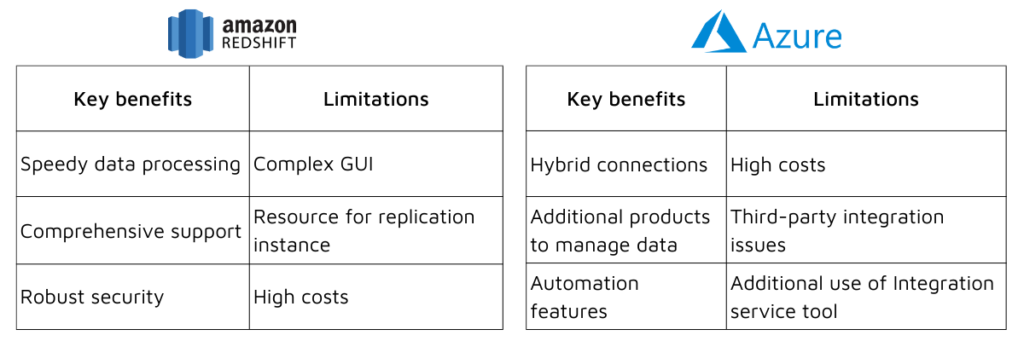
Whilst Redshift is often seen as not being as cost-effective as some other cloud solutions, the platform has been praised for providing better support and security features than its rivals; and although the GUI is considered far too complex for first-time users, it generally provides a faster data processing speed than its competitors (including Azure).
A known issue, that causes delays in data migration speed, is having inadequate resources allocated to the replication instance and if multiple tasks are being run across Redshift (as an endpoint), then they are more I/O intensive.
Azure – storing and migrating your data
Azure is designed to provide a reliable platform between on-premises and public cloud, with a broad range of hybrid connections (VPNs, caches, CDNS, etc) and hosts over 200 products to manage data solutions.
The database migration tool allows for a simple, guided, and automated migration service, which allows data migration from multiple sources to the cloud, at scale.
Azure for your data migration – the benefits and limitations
Azure data migration can be done using the tools provided (such as the Azure Data Factory) and has been noted for allowing large data loads, control of the process, and effort / time saved on data partitions and solutions created for high resilience.
The connector for migrating from Amazon Redshift to Azure is a supported capability.
Some users have found issues with Azure include sorting out third-party integration points (such as mail servers, data processors, etc) and needing to use the separate Azure Integration Service tool to make the process easier and having to factor this into their data migration plans.
What are the differences between Redshift and Azure?
The two platforms differ in a number of key areas, which can make the services more or less suitable for your needs, depending on what you require after you have finished migrating data.
Redshift has clusters with ‘nodes’, and configurations that bundle CPU, memory storage, and IOPS – and they offer three types of ‘on-demand’ nodes (with different performance levels.
Azure, tends to price compute and storage resources separately with Data Warehouse Units (DWU) comprising of CPU, Memory, and IOPS being one price, and the storage at another rate.
To protect the data, Redshift automatically takes incremental snapshots that track changes to the cluster – it does this by default every eight hours, or every 5GB (per node) of data change (whichever comes first).
On the other hand, Azure takes automatic screenshots throughout the day (to create restore points which are available for 7 days) and allows users to trigger up to 42 user-defined snapshots.
What to consider before migrating your data?
Depending on the size of your data migration, you may need to integrate different tools or functions into your planning, and carefully evaluate both platforms to determine which is going to provide a better fit, and a more cost-effective, successful solution.
Effective planning of your data migration project is key, read the full article on how to plan your data migration.
Ardent data migration solutions
If you are considering migrating data from Redshift to Azure or are yet to decide on technology and are still exploring your options, our experienced data engineers can help. We have worked with a wide variety of clients, data and technologies to deliver data migration solutions quickly and efficiently. If you are looking to migrate your data from redshift to Azure or vice versa, our highly skilled data engineers can help. Get in touch to find out more or to get started.
Ardent Insights
Data Warehousing Architecture: Azure SQL vs Redshift
There are quite a few different data warehouse technologies to choose from, and knowing where to start, what to look for, and what data warehouse service is going to be best for your business is key. Deciding on a data warehousing technology that is suitable to your business needs, goals and objective is essential as [...]
Read More... from Migrating Data from Redshift to Azure: What you need to know

Data Warehouse vs Database: The key differences
Cloud technology and advances in hybrid-storage technologies have meant that data storage is no longer left entirely to internal equipment and a single company-owned server. Finding a database management solution that works with the size and scale of your needs is not a task to be overlooked. [...]
Read More... from Migrating Data from Redshift to Azure: What you need to know

Building data pipelines – a starting guide
Data visibility can be a huge driving factor for organisation growth. Poor data visibility can lead to a lack of compliance with data security, difficulty in understanding business performance and increased complexity in dealing with system performance issues. Developing secure, robust and scalable data pipelines can empower businesses to gain data visibility by connecting the [...]
Read More... from Migrating Data from Redshift to Azure: What you need to know

Services
About
UK
US
India

