Hybrid cloud or multi-cloud – what’s the difference and what is right for you?
20 July 2022 | Noor Khan



Cloud adoption continues to accelerate, particularly with the drive during the pandemic when organisations around the world were forced to work remotely. According to a report by Flexera, around 92% of organisations have a multi-cloud strategy in place whilst 80% of organisations have a hybrid cloud strategy. Organisations will continue to embrace the different cloud strategies and solutions to reap the unmatched benefits on offer.
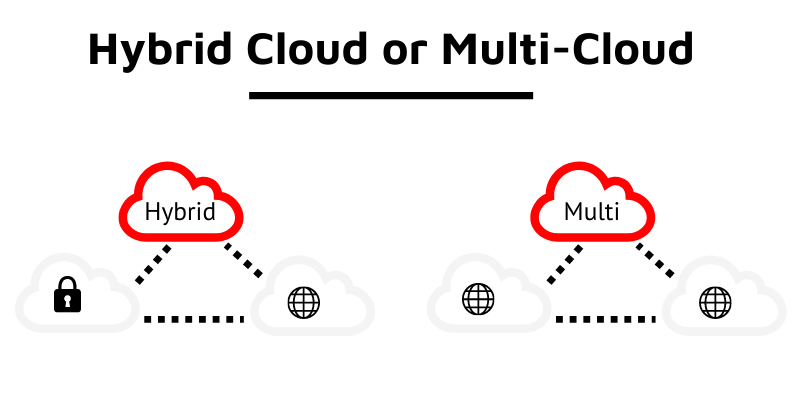
In this article, we will look at hybrid cloud or multi-cloud, highlighting the benefits and limitations, the key difference and choosing the right solution for you. Ardent cloud engineers have helped several clients with data migration, moving their data to both a hybrid cloud and a multi-cloud environment.
What is a hybrid cloud?
A hybrid cloud is when an organisation will make use of more than one cloud environment to run their applications and store their data. The most commonly used hybrid cloud consists of utilising both private and public clouds. An organisation may have an on-premises cloud infrastructure in place, which is usually referred to as a private cloud. They may also want to take advantage of off-premise cloud solutions such as those offered by Microsoft Azure and AWS. A hybrid solution enables businesses to connect their cloud solutions for greater flexibility with their data.
Benefits of hybrid cloud
There are many hybrid cloud benefits which will vary for different types of organisations, however, these are some of the key benefits that a hybrid cloud solution offers.
Improved security
With a hybrid cloud, businesses may opt to store their most private and private data on their private cloud and opt to have their less sensitive data on a public cloud. Improving overall data security. Public cloud vendors also offer data security with encryption and more.
Support remote teams
Remote work is on the rise. According to Cloud Wards, 51% of workers prefer to work either hybrid or fully remote, driving the movement to cloud solutions. Hybrid cloud, therefore, offers the ideal solution for organisations with a remote workforce.
Long-term lower costs
On-premise, private cloud solutions storing an entire organisation's data can be expensive to maintain and manage. Therefore, opting for a hybrid solution will lower long-term costs.
Increase scalability
A hybrid cloud solution meets an organisation fluctuating demands at a lower cost and enables businesses to scale their data accordingly.
Business continuity
As opposed to a single cloud solution, businesses can ensure business continuity as their data is distributed across both private and public cloud solutions.
Limitations of hybrid cloud
The following are some of the limitations organisations may face if they were to employ a hybrid cloud environment.
Hardware costs
Setting up an on-premise private cloud environment can be incredibly costly to organisations. The costs will vary for each organisation depending on their requirements, however, the use of public clouds may be a cost-effective alternative.
Implementation costs
Although the hybrid cloud may offset the costs long term, organisations must make the initial investment costs which can be quite substantial. Implementing a hybrid cloud solution can be complex with on-premise infrastructure and integrating with a public cloud.
Data visibility
Data will be spread across both types of cloud, therefore there may be limitations when it comes to data visibility. Monitoring systems, applications and data across both cloud environments may require expert skills.
What is multi-cloud
A multi-cloud infrastructure consists of two or more cloud solutions of the same type. For example, two or more private cloud environments or two or more public cloud environments. Organisations will utilise multi-cloud deployment for a number of reasons including, connectivity of apps and data, avoiding vendor lock-in and more.
Benefits of multi-cloud
There are multiple benefits to gain from a multi-cloud infrastructure and they are as follows:
Avoid vendor lock-in
Vendor lock-in restricts organisations from moving or changing their cloud vendors as it is not a practical option for them. With multi-cloud, you can mix and match to meet your business needs and requirements.
Flexibility and speed
To support a rapid speed of innovation, you can leverage the most suitable technology platforms.
Best of all platforms
You can access the best cloud technologies on offer and gain benefits across each cloud platform.
Cost savings
You have the flexibility to choose the most cost-efficient vendors as you are not restricted to just one cloud vendor and their offerings.
Reliability
Your data will be distributed across many cloud platforms, therefore, you have increased reliability on data being available should there be any issues with a particular platform.
Limitations of multi-cloud
These are some of the limitations to consider when it comes to choosing the multi-cloud environment for your organisation.
Management
There more cloud platforms an organisation employs as part of their cloud strategy, the complexity increases when it comes to effectively managing those platforms and gaining full visibility.
Security risks
There is a greater exposure as data is spread on a number of cloud platforms.
Differences in infrastructure
Each platform and cloud environment will have a different infrastructure, this inconsistency can become an issue when it comes to implementing changes quickly, across all cloud platforms.
Cloud technologies
According to Gartner, spending on public cloud services is predicted to be $397 billion in 2022, a significant increase from 2020, when the spend was estimated to be around $270 billion. Therefore, most organisations will be looking to invest in public cloud services. There are some of the big players in the cloud technologies market that you might want to consider for your cloud solution.
AWS
According to Statista, in the last quarter of 2021, AWS was the cloud vendor of choice with the biggest market share of 33%.
Read our success story, delivering a project with AWS.
Microsoft Azure
Azure, comes in second with a 22% market share in the same period.
Read about our client project working with Microsoft Azure.
Google Cloud
Google cloud secured 9% of the market share in the same period.
These are the top three leading cloud vendors which empower organisations to drive to a cloud-driven future. At Ardent, our engineers have leveraged technologies on offer by each vendor to deliver on client projects.
Differences between hybrid cloud and multi-cloud
Hybrid cloud and multi-cloud are terms which are often used interchangeably or are confused with each other. Although both employ cloud infrastructures for their cloud solutions, there is a key distinction between the two. A hybrid cloud constitutes two or more cloud infrastructures, whereas a multi-cloud infrastructure constitutes different clouds of the same type.
Ardent cloud services
Our highly skilled cloud engineers have worked with a wide variety of cloud technologies to empower clients to increase flexibility, reduce long terms costs and scale their business. If you are looking to migrate your data, or are considering a hybrid cloud or multi-cloud infrastructure for your cloud solution, then get in touch.
Ardent Insights
Data Warehousing Architecture: Azure SQL vs Redshift
There are quite a few different data warehouse technologies to choose from, and knowing where to start, what to look for, and what data warehouse service is going to be best for your business is key. Deciding on a data warehousing technology that is suitable to your business needs, goals and objective is essential as [...]
Read More... from Hybrid cloud or multi-cloud – what’s the difference and what is right for you?

Data Warehouse vs Database: The key differences
Cloud technology and advances in hybrid-storage technologies have meant that data storage is no longer left entirely to internal equipment and a single company-owned server. Finding a database management solution that works with the size and scale of your needs is not a task to be overlooked. [...]
Read More... from Hybrid cloud or multi-cloud – what’s the difference and what is right for you?

Building data pipelines – a starting guide
Data visibility can be a huge driving factor for organisation growth. Poor data visibility can lead to a lack of compliance with data security, difficulty in understanding business performance and increased complexity in dealing with system performance issues. Developing secure, robust and scalable data pipelines can empower businesses to gain data visibility by connecting the [...]
Read More... from Hybrid cloud or multi-cloud – what’s the difference and what is right for you?
Services
About
UK
US
India

