What is schema optimisation and why do you need to optimise your schema
22 September 2022 | Noor Khan



When utilising cloud services and data warehouses, the relationships of your data forms will lead to the creation of a database schema. Simply put, a schema is an abstract design which represents the storage of the data in the database – the term applies to both the organisation of the data and how the tables in a given database are related to one another.
Schema optimisation is an efficient tool for maximising the speed and efficiency of your database and allowing performance enhancement through design that addresses functional needs. In this article, we will look at why you need to optimise your schema and the benefits to gain from it.
How does optimising your schema benefit you?
With many platforms operating on pay-as-you-use payment methods to use the service, time is precious – and you do not want to be spending unnecessary time and money waiting for processes to complete.
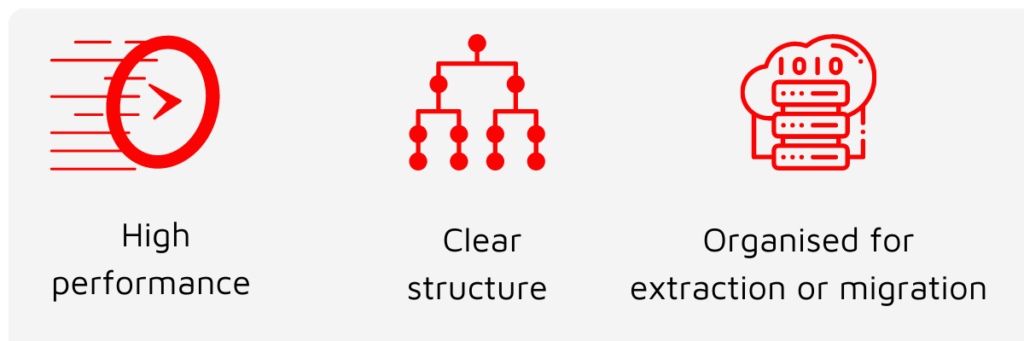
Having a strategy for database optimisation can help to reduce the system response time, provide a clear and easily indexable or searchable structure, and allow for content to be extracted, migrated, or arranged with minimal resource wastage. To reduce performance issues that occur with overly complicated object models and database schema, optimisation is required.
What technology is used to effectively optimise schema?
To optimise a schema, various cloud platforms have tools available, including the likes of Azure SQL Database, or AWS’s Schema Conversion Tool. There is also the option on many platforms to manually improve database structure, this could be through index suggestions, removal of unused tables or columns, identifying and fixing invalid class mappings, reducing disk access, or improving caching.
What you need to consider before optimising your data schema
It is essential that before you start making changes or alterations to your schema, your data is backed up. Although this should be standard practice to avoid the loss of data and ensure data consistency, this is even more paramount when making significant changes. If your data is backed up and you run into any issues, or the optimisation does not produce the intended results, you can still recall your previous schema and undo any changes.
It’s important to remember that a de-normalised schema can speed up some queries but may slow down others, and although removing tables or columns may reduce space, they should be carefully checked to ensure they are not tied into any other operations that require the data to be in place.
Depending on the cloud platform you’re using for your data, there may be specific tools, access to knowledge bases, or advice available to support your optimisation process – it is highly recommended that you look at the available help and support before making changes to your schema, so you can identify exactly what processes your provider is using, what level of technical understanding you need to have to conduct the optimisation, and have access to troubleshooting should the process not go according to plan.
Continuous optimisation
Creating a well-designed data schema which will optimise the performance of your data is great, however, it will need consistency and continuous optimisation. Your database will only work as well as it is structured, and as your data sets evolve and grow regular optimisation and management will be required and should be a key element of your process.
Ardent data schema optimisation services
Our highly skilled data engineers have worked on a wide variety of data warehousing projects including the optimisation of their data schema. If you have low, declining performance or lack consistency in your data structure, Ardent can help. Our engineers can either optimise your existing schema structure or architect a sophisticated data warehouse to optimise your data performance, data accessibility and data speed. Explore our data warehousing service or get in touch to enhance your data performance.
Ardent Insights

Data Warehousing Architecture: Azure SQL vs Redshift
There are quite a few different data warehouse technologies to choose from, and knowing where to start, what to look for, and what data warehouse service is going to be best for your business is key. Deciding on a data warehousing technology that is suitable to your business needs, goals and objective is essential as [...]
Read More... from What is schema optimisation and why do you need to optimise your schema

Data Warehouse vs Database: The key differences
Cloud technology and advances in hybrid-storage technologies have meant that data storage is no longer left entirely to internal equipment and a single company-owned server. Finding a database management solution that works with the size and scale of your needs is not a task to be overlooked. [...]
Read More... from What is schema optimisation and why do you need to optimise your schema

Building data pipelines – a starting guide
Data visibility can be a huge driving factor for organisation growth. Poor data visibility can lead to a lack of compliance with data security, difficulty in understanding business performance and increased complexity in dealing with system performance issues. Developing secure, robust and scalable data pipelines can empower businesses to gain data visibility by connecting the [...]
Read More... from What is schema optimisation and why do you need to optimise your schema

Services
About
UK
US
India

